Blog
Which Creator Skills Are Most In Demand?
2026-07-29The creator skills brands and clients value most in 2026—from video editing and storytelling to AI literacy, audience growth and commercial strategy.
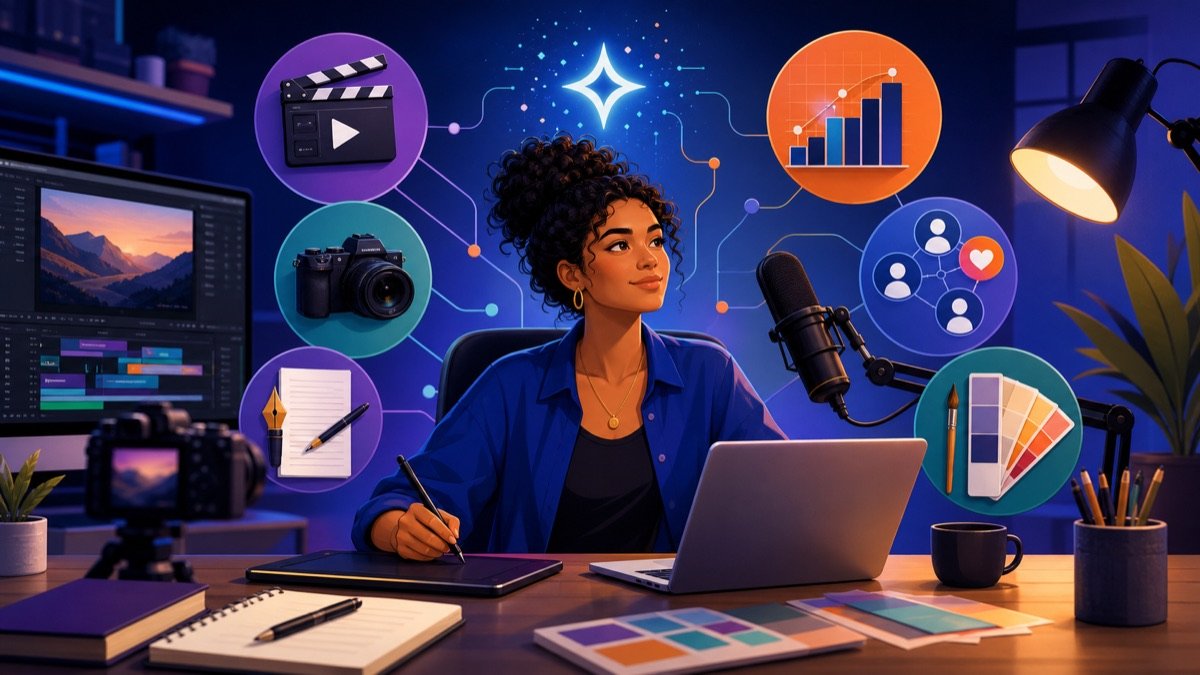
The most valuable creators in 2026 are rarely defined by one platform or one technical skill. They combine a strong creative craft with audience understanding, reliable execution and the ability to connect content to a business goal.
Demand also varies by niche. A beauty brand may prioritise short-form video and on-camera presence, while a software company may need educational storytelling, screen recording and conversion-focused writing. Even so, current hiring and advertising data reveals a clear set of transferable skills.
The most in-demand creator skills in 2026
- Short-form video production and editing
- Storytelling and copywriting
- Social media strategy and audience growth
- AI literacy and AI-assisted production
- Brand strategy and visual identity
- SEO and content discovery
- Analytics, attribution and reporting
- Community building and communication
- Sales, negotiation and partnership management
- Subject-matter expertise and teaching
1. Short-form video production and editing
Video editing ranked second in Upwork's 2025 Design & Creative demand list, with video production also in its top ten. For creators, demand extends beyond operating editing software. Clients value people who can find a hook quickly, structure a story for retention, select strong visuals, clean up audio, add readable captions and adapt one idea for several formats.
A useful portfolio should show the outcome, not just transitions and effects. Include examples of an educational video, a product demonstration, a testimonial or case study, and a personality-led short. Demonstrating taste and pacing is more persuasive than listing ten editing tools.
2. Storytelling and copywriting
Every format needs a story. In a 20-second reel, it may be a hook, tension and payoff. In a newsletter, it may be a useful insight supported by an example. In a brand collaboration, it is the ability to introduce a product without losing the creator's natural voice.
Creators should practise:
- hooks and headlines that make a specific promise;
- scripts that sound natural when spoken;
- clear calls to action;
- email, caption and landing-page copy;
- interviewing and turning real experiences into narratives.
AI can produce a draft, but judgement, accuracy, tone and lived experience are what make the final work distinctive.
3. Social media strategy and audience growth
Social media marketing ranked first in Upwork's 2025 Sales & Marketing category. The in-demand skill is broader than posting regularly. It includes positioning, content pillars, channel selection, series development, publishing cadence, community response and experimentation.
A strong strategist can explain why a format suits an audience, what success should look like and what to change after reviewing the results. Creators who understand both content and distribution are easier for brands to trust with campaigns.
4. AI literacy and AI-assisted production
LinkedIn identified AI literacy as one of the fastest-growing skills across several countries and job functions in its 2025 Skills on the Rise analysis. IAB also reported that nearly three in four creator ad buyers were already using or planning to use AI for creator marketing.
For creators, practical AI literacy means knowing how to use tools for research, ideation, transcription, rough edits, repurposing and workflow automation—and knowing when not to use them. Verification, copyright awareness, privacy, disclosure and human review are part of the skill.
The goal is better creative work and faster iteration, not generic output. A creator's perspective, taste and relationship with the audience remain difficult to automate.
5. Brand strategy and visual identity
Graphic design topped Upwork's 2025 Design & Creative list, while brand identity design also appeared in the top ten. Creators benefit from understanding typography, colour, composition, thumbnail design and basic art direction even when they eventually hire a designer.
Consistency makes a creator easier to recognise. More importantly, brand strategy helps answer: Who is this for? What should they remember? Why should they trust this creator? A clear identity should support those answers instead of becoming decoration.
6. SEO and content discovery
SEO ranked second in Upwork's Sales & Marketing list. Search skills matter beyond traditional websites: people search on video platforms, social networks, marketplaces and community sites as well as Google.
Creators should learn search intent, topic research, descriptive titles, useful headings, metadata and internal linking. Evergreen, searchable content can continue attracting an audience long after a trend has disappeared.
7. Analytics, attribution and reporting
IAB's creator advertising research highlights a growing demand for attribution, consistent reporting and audience authentication. Brands increasingly want to know what happened after content was published.
A creator does not need to become a data scientist. They should be able to interpret reach, retention, saves, clicks, conversion rate and audience quality; compare results with the campaign objective; and turn the findings into a concise report. The ability to recommend a next experiment is especially valuable.
8. Community building and communication
LinkedIn's analysis repeatedly surfaced communication, relationship building, strategic thinking and adaptability among fast-growing skills. These human capabilities are central to creator work.
Community building means listening, responding, setting healthy boundaries, moderating discussions and creating reasons for people to return. It also means communicating reliably with clients and collaborators. Trust compounds slowly, but it is one of the creator economy's strongest assets.
9. Sales, negotiation and partnership management
Creators running independent careers need commercial skills. They must understand a brief, scope the work, price usage rights, discuss exclusivity, set revision limits, invoice clearly and follow up professionally.
This is not about becoming aggressive at sales. It is about making the value exchange clear and protecting both sides from avoidable misunderstandings. Creators who deliver on time and communicate early are often rehired.
10. Subject-matter expertise and teaching
Production quality can attract attention, but useful knowledge gives people a reason to stay. Expertise may come from a profession, craft, lived experience or years spent studying a narrow interest. The complementary skill is teaching: breaking complex ideas into accurate, understandable steps.
This combination is especially valuable for educational content, product demonstrations, workshops, courses, consulting and specialist brand partnerships.
Which skill should a creator learn first?
Choose one core craft and one growth skill.
- Core craft: video, photography, writing, audio, design, performance or teaching.
- Growth skill: distribution, SEO, analytics, community, sales or AI-assisted workflow.
For example, a video creator could pair editing with audience analytics. A writer could pair storytelling with SEO. A photographer could pair visual identity with partnership sales. This creates a useful “skill stack” without trying to master everything at once.
How to prove an in-demand creator skill
Evidence is stronger than a skills list. Build three to five focused portfolio examples and explain the brief, your decisions and the result. Where possible, include measurable outcomes such as watch time, qualified enquiries, saves, click-through rate or repeat commissions.
The creator market rewards people who can make strong work, understand why it works and collaborate professionally. Tools and platforms will keep changing; those three capabilities remain durable.
Sources
- Upwork: 2025's Most In-Demand Skills
- LinkedIn: Skills on the Rise in 2025
- IAB: 2025 Creator Economy Ad Spend & Strategy Report
Demand signals were reviewed in July 2026. Rankings cited from labour platforms reflect their own datasets and should be treated as directional rather than a universal ranking for every creator niche or country.